
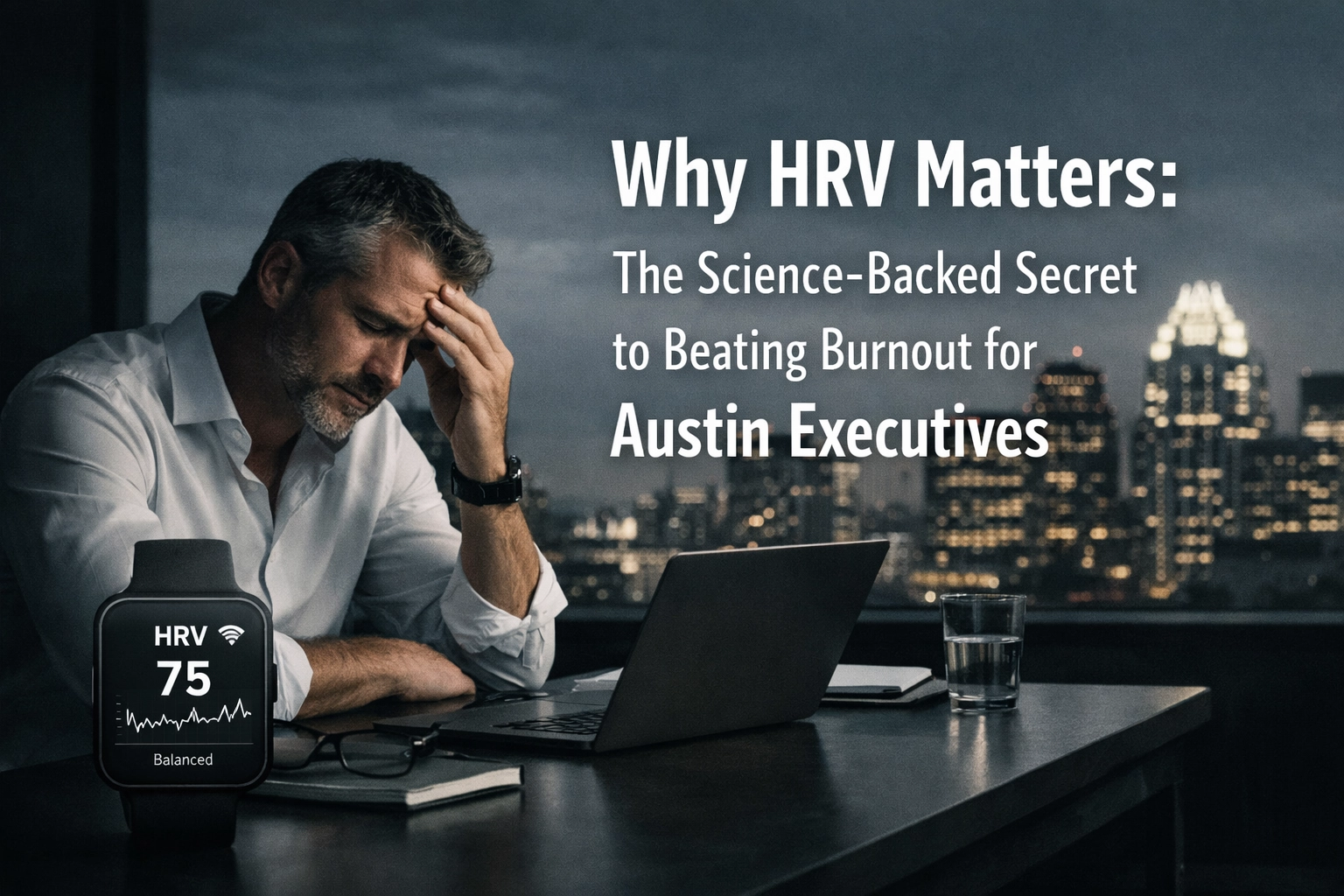
In the high-stakes environment of Austin’s boardroom culture: from the tech corridors of North Austin to the venture capital hubs downtown: burnout is often viewed as an inevitable cost of doing business. You manage complex portfolios, lead multi-national teams, and navigate volatile markets. However, the physiological toll of this sustained pressure is measurable, and more importantly, it is manageable.
Recent data suggests that burnout isn’t just a “feeling”; it is a systemic physiological failure. Research tracking high-pressure professionals over 2,379 person-days has identified a critical biomarker that predicts your resilience to stress: Heart Rate Variability (HRV). For the modern executive, HRV is the most important metric you aren’t currently tracking. It is the “early warning system” that tells you whether your body is ready to perform or on the verge of a breakdown.
1. Understand the Physiology of Performance: What HRV Actually Is
While your heart rate measures the number of beats per minute, Heart Rate Variability measures the specific time variation between those individual heartbeats. If your heart rate is 60 beats per minute, it doesn’t actually beat once every second. There might be 0.9 seconds between two beats and 1.1 seconds between the next.
This variation is controlled by your Autonomic Nervous System (ANS), which is divided into two branches:
- The Sympathetic Nervous System: Your “fight-or-flight” response (the gas pedal).
- The Parasympathetic Nervous System: Your “rest-and-digest” response (the brake).
Fact: High HRV indicates a balanced nervous system that can switch between high-intensity focus and deep recovery with ease. Low HRV signals that your “gas pedal” is stuck to the floor, leaving you in a state of chronic sympathetic dominance.
For an executive personal training client, a high HRV means your body is resilient. It means you can handle a high-stress quarterly review and still recover overnight. A consistently low HRV, however, is a biological red flag that burnout is imminent.

2. The Science of Resilience: How HRV Buffers Stress
The correlation between HRV and mental stamina is backed by rigorous clinical data. In a landmark study published in the journal Psychosomatic Medicine, researchers found that individuals with high resting HRV experienced significantly reduced sensitivity to stress.
Specifically, the study revealed that high HRV serves as a “buffer” in two distinct ways:
- Reduced Stress Sensitivity: High HRV professionals reported lower perceived stress even when objective work demands increased.
- Mitigated Mental Exhaustion: On days with peak stress levels, those with higher HRV were significantly less likely to experience the “mental fog” or emotional exhaustion associated with burnout.
If you are an Austin executive looking to maintain a competitive edge, you must view HRV as your internal fuel gauge. When the gauge is high, you can push. When it is low, pushing further doesn’t lead to better results: it leads to physiological “debt.”
Fact: Research shows that mental exhaustion reduces your resting HRV the following morning, creating a negative feedback loop where today’s burnout makes you even more vulnerable to tomorrow’s stress.
3. Identify the “Feedback Loop” Before It Becomes Chronic
Burnout does not happen overnight. It is the result of a feedback loop problem. When you experience high levels of mental exhaustion, your parasympathetic nervous system (the brake) loses its “tone.” This leads to a lower HRV reading the next day.
With a lower HRV, your nervous system is less capable of handling even minor stressors. You become more reactive, less creative, and your decision-making abilities decline. If you continue to train hard or work 14-hour days during this dip, you deepen the exhaustion, further lowering your HRV.
By working with a personal trainer in Austin who understands these metrics, you can interrupt this cycle. Instead of guessing how hard to push, you use data to dictate your intensity.
Implementation Strategy:
- Track Daily: Use a wearable (Whoop, Oura, or Garmin) to establish a baseline.
- Assess the Trend: Do not react to a single low day. Look for a 3-day downward trend.
- Pivot Your Intensity: If your HRV is 20% below your baseline, prioritize recovery-based movement rather than high-intensity intervals.

4. Why Lean Muscle is an Executive Longevity Hack
For the Austin professional, “fitness” often gets equated with long sessions of steady-state cardio. However, for managing HRV and preventing burnout, lean muscle development is superior.
Muscle tissue acts as a metabolic sink and a buffer for the stress hormone cortisol. Strength training, when programmed correctly by a mobile personal trainer, helps improve “vagal tone”: the strength of your parasympathetic nervous system’s ability to pull you back into a calm state.
Numerical Claim: Improving your lean muscle mass can lead to a 15-20% improvement in metabolic efficiency, which directly correlates with higher resting HRV and improved sleep quality.
At Invictus Fitness, our in-home transformation program focuses on building this functional muscle without adding to your stress “bucket.” We prioritize movements that increase your power and stability while monitoring your recovery metrics to ensure we aren’t over-taxing your system.
5. Tactical Stress Management: Implementing the “Micro-Workout”
The biggest obstacle for Austin executives isn’t a lack of discipline; it’s a lack of time. When you are in the middle of a merger or a product launch, a 90-minute gym session is often the first thing to be cut. This is where the “Micro-Workout” or “Movement Snack” becomes a clinical necessity.
Instead of viewing exercise as an all-or-nothing endeavor, implement these tactical strategies:
- The 10-Minute Resistance Circuit: Perform three sets of compound movements (squats, push-ups, planks) between back-to-back Zoom calls. This clears cortisol and signals to your brain that you are moving out of a sedentary “stress state.”
- Zone 2 Breathwork: Incorporate 5 minutes of box breathing (4 seconds in, 4 seconds hold, 4 seconds out, 4 seconds hold) immediately following a high-stress meeting. This has been shown to acutely increase HRV in real-time.

6. The Role of Concierge Personal Training in Burnout Prevention
For many high-performers, the friction of getting to a gym is the final straw that breaks their consistency. This is why concierge, in-home training is becoming the standard for the Austin elite. By bringing the expertise to your home or office, you eliminate the “transition cost” of fitness.
A dedicated personal trainer in Austin acts as your performance manager. They don’t just count reps; they analyze your HRV, monitor your sleep data, and adjust your session in real-time. If you arrive for your session with a suppressed HRV and visible signs of autonomic fatigue, your trainer will pivot the session from “stress-inducing” to “recovery-promoting.”
Fact: Clients who utilize in-home, one-on-one training report a 65% higher adherence rate compared to those with traditional gym memberships, leading to more consistent improvements in stress-resilience biomarkers.
7. Actionable Takeaways for the Austin Executive
To move from a state of near-burnout to peak performance, you must treat your biology with the same rigor you treat your business analytics.
- Invest in Bio-Feedback: If you aren’t measuring your HRV, you are flying blind. Start tracking tonight.
- Prioritize Strength Over Miles: Build the “metabolic armor” of lean muscle to buffer stress.
- Audit Your Recovery: Ensure your sleep hygiene is non-negotiable. Aim for a consistent wake-up time to stabilize your circadian rhythm.
- Remove Friction: If time is your scarcest resource, look into one-on-one personal training that comes to you.
Burnout isn’t a badge of honor; it’s a sign of inefficient systems. By optimizing your HRV and focusing on science-backed recovery and strength strategies, you can maintain your high-performance lifestyle in Austin without sacrificing your long-term health.
If you are ready to stop guessing and start optimizing, our team at Invictus Fitness specializes in helping executives like you master their physiology. Reach out to us via our contact page to schedule a consultation and see how we can help you build a more resilient version of yourself.