
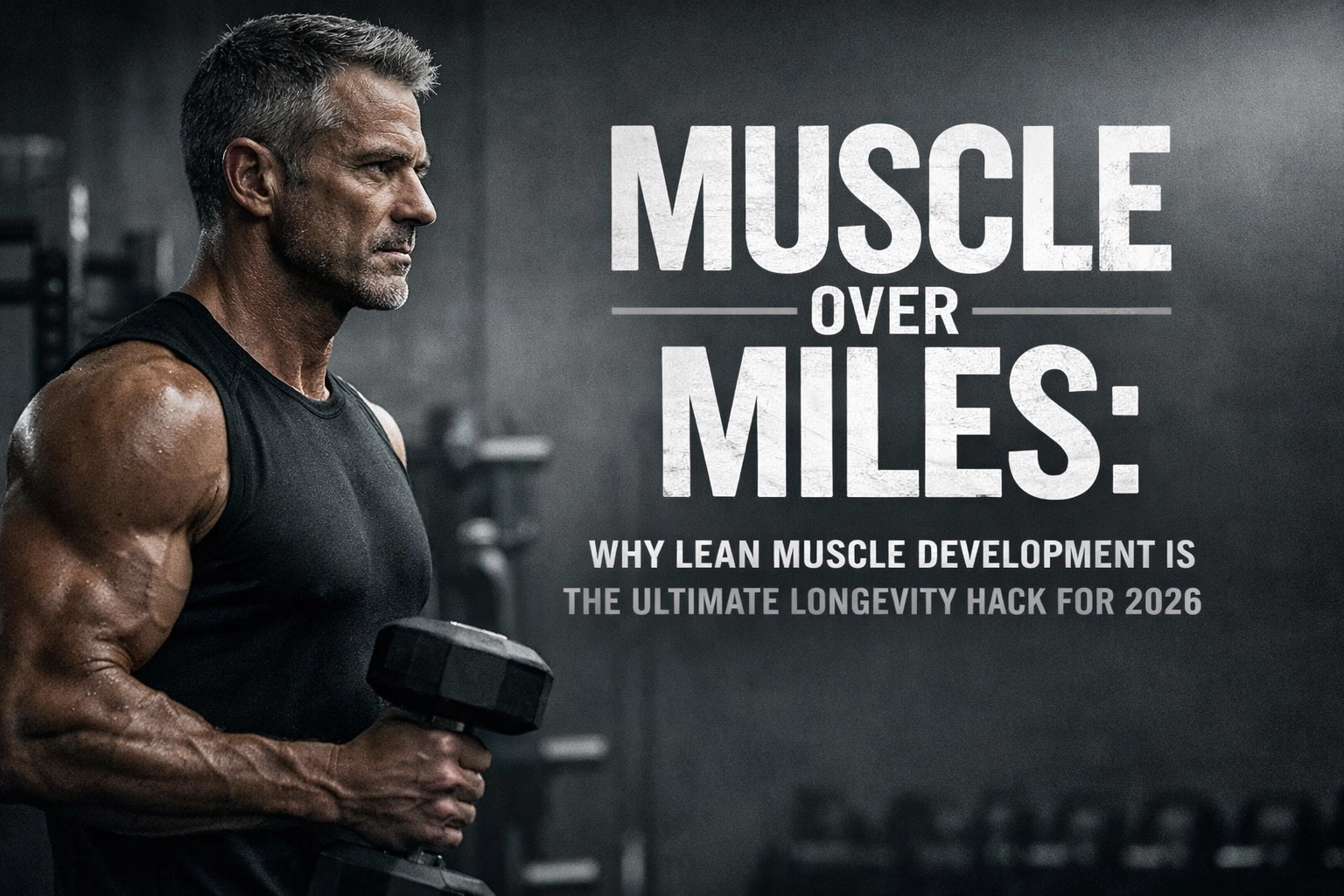
For decades, the gold standard of health was measured by the stopwatch and the treadmill. If you were “fit,” you were a runner. But as we move through 2026, the scientific community has reached a definitive consensus: your skeletal muscle mass is a more accurate predictor of how long you will live: and how well you will live: than almost any other metric.
Recent research reveals a sobering reality for those neglecting strength training: individuals with low muscle mass face an approximately 57% higher risk of all-cause mortality compared to those with normal muscle levels. While cardiovascular health remains essential, “miles” alone cannot protect you from the physiological decline that begins in your thirties.
For the high-performing Austin professional, the shift from “cardio-centric” workouts to lean muscle development is not just an aesthetic choice; it is a strategic investment in your biological future.
1. Prioritize Muscle Strength Over BMI for Lifespan Prediction
Data now confirms that muscle strength is a far more potent predictor of lifespan than Body Mass Index (BMI). In a study of adults over the age of 60, those in the lowest third for muscle strength were 50% more likely to die from all causes than those in the upper third. This protective effect isn’t limited to old age; it begins the moment you start building a “metabolic reserve.”
Muscle acts as a physiological buffer. When your body faces acute stress: whether from surgery, a severe viral infection, or chronic psychological stress: it draws upon the amino acids stored in your muscle tissue to fuel the immune system and facilitate repair. Without this reserve, your recovery capacity is significantly diminished.
Fact: After the age of 30, physically inactive individuals can lose as much as 3% to 5% of their muscle mass per decade. This condition, known as sarcopenia, is the primary driver of frailty and metabolic decline.
Actionable Takeaway: Shift your primary metric of success from “weight lost” to “strength gained.” Track your compound lifts (squats, presses, pulls) and aim for progressive overload every week to ensure you are actively combatting age-related muscle loss.

2. Achieve Sustainable Fat Loss Through Metabolic Rate Elevation
The most common mistake made by busy executives in Austin is attempting to lose weight through excessive calorie restriction and “burning it off” with miles of running. This often leads to “skinny fat” syndrome: a state where you lose weight, but a significant portion of that weight is lean muscle tissue, not fat.
Lean muscle development is the only way to achieve sustainable fat loss. Muscle is metabolically expensive tissue; even at rest, it requires more energy to maintain than body fat. By increasing your muscle mass, you effectively raise your Basal Metabolic Rate (BMR).
- The Thermic Effect: Strength training creates a “post-burn” effect (excess post-exercise oxygen consumption) that keeps your metabolism elevated for up to 72 hours after your session.
- Insulin Sensitivity: Muscle is the primary site for glucose disposal. More muscle means your body can process carbohydrates more efficiently, preventing the insulin resistance that leads to mid-section fat gain.
If you are looking for long-term results, you must stop viewing exercise as a way to “earn your food” and start viewing it as a way to build a more efficient engine.
Actionable Takeaway: Incorporate resistance training at least three times per week. Focus on multi-joint movements that recruit the most muscle fibers, such as deadlifts or weighted lunges. If your schedule is packed, a mobile personal trainer can bring the necessary equipment to your home, ensuring consistency without the commute.
3. Reduce Cardiovascular Disease Risk by 40%
While running is often touted as the “heart-healthy” choice, resistance training offers unique cardiovascular protections that shouldn’t be overlooked. Research indicates that consistent strength training can reduce the risk of heart disease by as much as 40%.
This reduction is achieved through several pathways:
- Lowering Systemic Inflammation: Strength training reduces C-reactive protein levels, a key marker of heart disease.
- Improved Lipid Profiles: Regular lifting helps increase HDL (good cholesterol) while managing LDL (bad cholesterol).
- Blood Pressure Regulation: Contrary to the myth that lifting raises blood pressure, long-term resistance training is associated with lower resting blood pressure.
For the executive dealing with high-stress environments, these cardiovascular benefits are a critical defense mechanism against the “silent killers” of the corporate world.

4. Enhance Cognitive Function and Executive Brain Power
In 2026, we understand that the brain and the brawn are inextricably linked. When you engage in intense resistance training, your muscles release myokines: signaling molecules that cross the blood-brain barrier.
One of the most critical of these is Brain-Derived Neurotrophic Factor (BDNF). BDNF acts like “Miracle-Gro” for the brain, supporting the survival of existing neurons and encouraging the growth of new ones. Studies show that resistance training specifically improves:
- Executive Function: The ability to plan, focus, and multitask.
- Memory Retention: Protection against the cognitive decline associated with aging.
- Mood Regulation: A natural reduction in cortisol (the stress hormone) and an increase in endorphins.
Fact: Resistance training in older adults has been shown to boost cardiotrophin-like cytokine factor 1 by nearly 70%, which directly supports bone density and metabolic health.
Actionable Takeaway: When you feel a “brain fog” mid-afternoon, don’t reach for a third espresso. A 20-minute high-intensity strength circuit can trigger the release of BDNF, providing a sharper mental edge for your next board meeting than any stimulant could.
5. Leverage the Support of a Personal Trainer in Austin
The theory of muscle development is simple, but the implementation for a high-level professional is complex. Between travel, meetings, and family obligations, finding the time to design and execute a hypertrophy-focused program is a significant hurdle.
This is where working with a personal trainer in Austin becomes a game-changer. A professional coach provides:
- Biomechanical Optimization: Ensuring you are lifting with perfect form to prevent injury (the biggest setback for longevity).
- Accountability: It is much harder to skip a workout when an in-home personal trainer is arriving at your doorstep.
- Data-Driven Programming: Using advanced metrics like Heart Rate Variability (HRV) and body composition analysis to ensure your lean muscle development is on track.
Invictus Fitness specializes in this high-touch approach, allowing you to focus on your career while we handle the science of your physical optimization.

6. The “Functional” Advantage: Protecting Your Mobility
Longevity isn’t just about adding years to your life; it’s about adding life to your years. The ability to travel, play with your grandchildren, and maintain independence is entirely dependent on your muscle mass.
Muscle protects your joints by absorbing the impact that would otherwise be felt by your knees, hips, and lower back. Strength training has been shown to improve bone density by putting healthy stress on the skeletal system, effectively reversing the early stages of osteoporosis.
Actionable Takeaway: Target “functional” strength. This means training movements, not just muscles. Exercises like the farmer’s carry, goblet squats, and overhead presses translate directly to real-world vitality.
Summary: Your Longevity Checklist for 2026
To maximize your healthspan and ensure you are part of the “upper third” of survivors, implement these strategies immediately:
- Stop the Cardio-Only Approach: While 150 minutes of zone 2 cardio per week is great, it must be supported by at least 2-3 days of heavy resistance training.
- Focus on Protein Intake: You cannot build lean muscle without the raw materials. Aim for 0.8g to 1g of protein per pound of target body weight.
- Track Your Strength, Not Just Your Scale: If your weight stays the same but your deadlift goes up by 20 pounds, you have successfully traded fat for muscle.
- Audit Your Recovery: Muscle isn’t built in the gym; it’s built during sleep. Prioritize 7-8 hours of quality rest.
- Seek Professional Guidance: Don’t guess. Partner with a personal trainer in Austin to create a bespoke plan that fits your unique lifestyle and goals.
The “Miles” will keep your heart ticking, but the “Muscle” will keep you moving. In the landscape of 2026, there is no greater longevity hack than a strong, resilient body.
Ready to start your transformation? Explore our one-on-one personal training options and take the first step toward a longer, more capable life.