
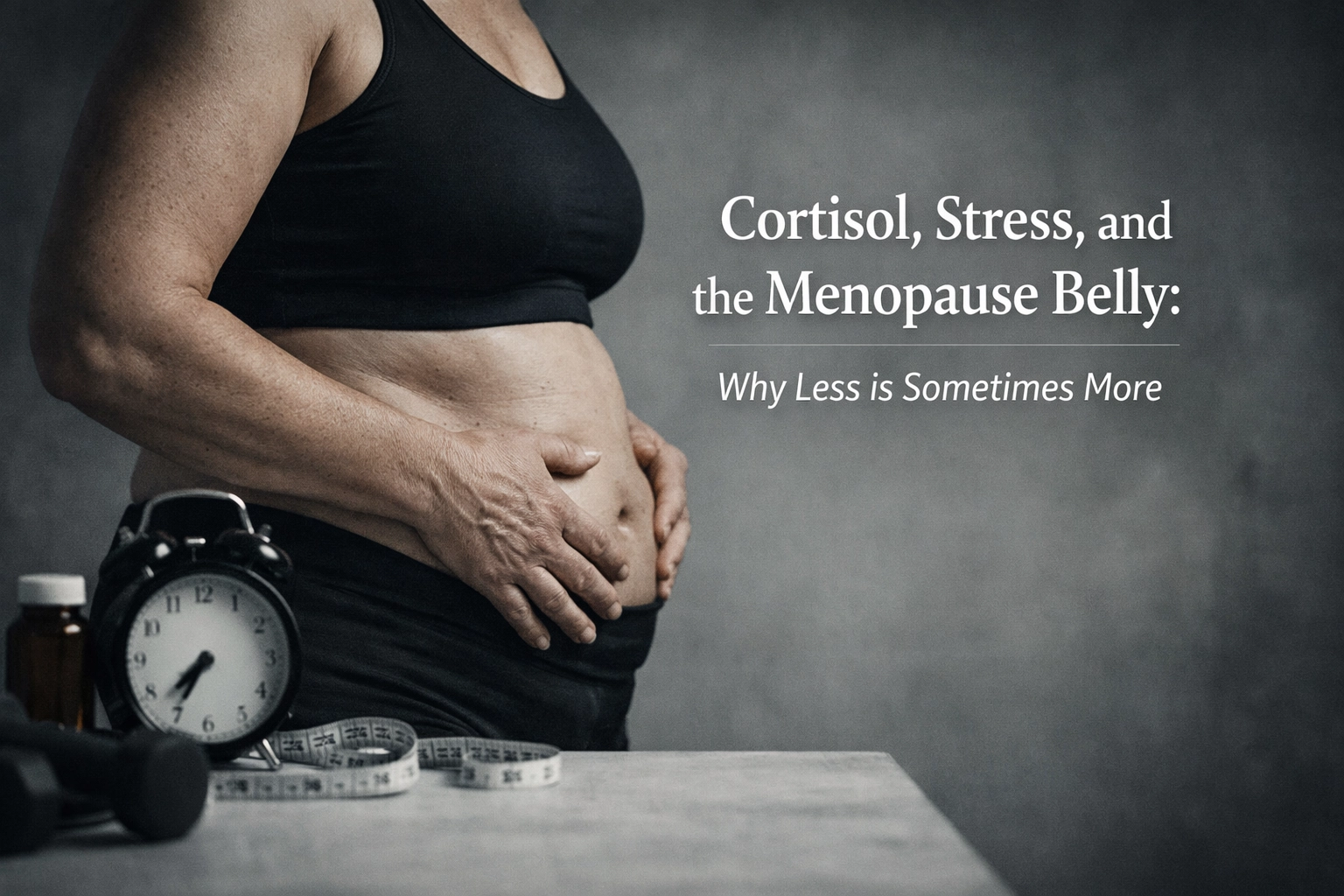
You’re doing everything right. You’re logging your daily runs, hitting spin class four times a week, and eating cleaner than you did in your thirties. Yet somehow, your favorite jeans don’t fit the same way, and that stubborn weight around your midsection won’t budge, no matter how many extra miles you add to your morning routine.
If this sounds familiar, you’re not alone. Research shows that during the menopausal transition, up to 70% of women experience weight gain, with most of it accumulating around the abdomen. But here’s what most women don’t realize: your go-to high-intensity workouts might actually be making the problem worse.
The Estrogen-Cortisol Connection You Need to Understand
When estrogen levels drop during perimenopause and menopause, you lose more than just reproductive hormones, you lose a critical stress buffer. Estrogen possesses natural anti-cortisol properties that help your body manage everyday stress. As estrogen declines, your ability to counteract cortisol’s negative effects diminishes significantly.
Fact: Studies show that cortisol levels rise among some women during the late stages of the menopausal transition, with declining estrone and rising FSH associated with increased overnight cortisol levels.
Think of estrogen as your body’s cortisol security system. When the system fails, cortisol (your primary stress hormone) runs unchecked through your body, looking for places to store energy. And it has a very specific target in mind.

Why Your Belly Becomes Cortisol’s Favorite Storage Unit
Here’s the biological truth that explains your changing body: deep abdominal fat contains four times more cortisol receptors than fat tissue anywhere else in your body.
This isn’t random. Your abdomen becomes cortisol’s preferred warehouse because it’s metabolically primed to receive and store stress-related fat. When you’re under chronic stress, whether from work demands, sleep disruption, relationship challenges, or the hormonal shifts of menopause itself, cortisol remains elevated throughout the day rather than following its normal morning-high, evening-low pattern.
This elevated cortisol signals your body to:
- Convert existing subcutaneous fat (the pinchable kind beneath your skin) into visceral fat (the deep, organ-surrounding kind)
- Store additional calories as abdominal fat rather than distributing them elsewhere
- Increase inflammatory markers that further promote fat storage
- Raise insulin resistance, making weight loss increasingly difficult
The visceral fat accumulation isn’t just cosmetic, it significantly increases your risk of cardiovascular disease, type 2 diabetes, and certain cancers.
The Exercise Paradox: When More Cardio Creates More Problems
Here’s where conventional fitness advice collides with menopausal biology: cortisol increases in workouts lasting more than 40 minutes, while mind-body exercises like yoga don’t produce this cortisol spike.
If you’re a high-performing professional in Austin juggling client meetings, project deadlines, and family obligations, your daily stress levels are already elevated. Your 60-minute spin class or 90-minute weekend run? They’re adding fuel to an already-burning fire.
This doesn’t mean exercise is bad, it means you need to exercise strategically. Your body during menopause requires a different approach than it did a decade ago. The “crush it every day” mentality that worked in your thirties and forties can backfire spectacularly when your hormonal landscape has fundamentally shifted.

What Actually Works: The Strength-First, Stress-Smart Approach
The solution isn’t exercising less, it’s exercising smarter. Research consistently shows that women who combine strength training with balanced, lower-intensity movement manage menopausal weight gain more effectively than those who rely primarily on cardio.
Why strength training wins during menopause:
1. It Builds Metabolically Active Tissue
Muscle tissue burns more calories at rest than fat tissue. As estrogen declines, you naturally lose muscle mass (approximately 3-8% per decade after age 30). Strength training reverses this trend, creating a metabolic advantage that cardio alone cannot provide.
2. It Improves Insulin Sensitivity
Resistance training helps your cells respond better to insulin, counteracting the insulin resistance that often accompanies menopause and directly combating belly fat accumulation.
3. It Doesn’t Spike Cortisol the Same Way
A focused 30-45 minute strength session creates a different hormonal response than prolonged cardio. You get the metabolic benefits without the extended cortisol elevation.
4. It Protects Bone Density
As estrogen declines, bone loss accelerates. Weight-bearing strength training maintains bone density in ways cardio cannot.
The Austin Advantage: Customized Programming for High-Performers Under Stress
At Invictus Fitness, we work with busy professionals who understand intellectually that they need to change their approach, but struggle with implementation. Our trainers specialize in menopause fitness programming that accounts for the unique stress profiles of executives, business owners, and high-achieving women.
Here’s what personalized concierge personal training looks like for our perimenopausal and menopausal clients:
Stress-State Assessment: We evaluate your current stress load, not just exercise stress, but your complete professional and personal demands. Your workout plan must fit within your total stress budget, not exceed it.
Periodized Programming: Your body can’t handle the same intensity every session. We cycle between strength-focused days, moderate-intensity movement, and active recovery that actually lowers cortisol rather than raising it.
Timing Optimization: For many of our Austin clients, training earlier in the day (when cortisol naturally peaks anyway) produces better results than evening sessions that can disrupt sleep and recovery.
Recovery Integration: Rest days aren’t optional, they’re strategic. We program restorative practices like yoga, walking, and breath work as essential components of your plan, not afterthoughts.

Your Practical Implementation Strategy
If you’re ready to work with your hormones instead of against them, start here:
Reframe Your Cardio:
Replace 60-minute steady-state cardio with 20-30 minute sessions. If you love running or cycling, keep them, just shorten the duration and reduce frequency to 2-3 times weekly instead of 5-6.
Prioritize Strength Training:
Aim for 3-4 strength sessions weekly, focusing on compound movements (squats, deadlifts, presses, rows). Each session should last 30-45 minutes, not 90.
Add Low-Intensity Movement Daily:
Walking, gentle yoga, or leisurely cycling don’t spike cortisol and actively support stress reduction. Target 30-60 minutes daily of this type of movement.
Monitor Your Recovery:
If you’re feeling constantly fatigued, irritable, or noticing worsening sleep, you’re likely over-training relative to your current stress capacity. Scale back intensity before adding more.
Consider Professional Guidance:
A personal trainer in Austin who specializes in menopause fitness can accelerate your progress by months or years compared to trial-and-error approaches.
The Stress Reduction Connection
Beyond exercise modification, effective stress reduction directly impacts your cortisol levels and belly fat accumulation. Our most successful clients implement:
- Morning mindfulness practices (even 5-10 minutes of breathwork or meditation)
- Evening wind-down routines that prioritize sleep quality
- Strategic “no” usage to protect their time and energy
- Professional support that removes decision fatigue around workouts
When you’re managing a demanding career, family responsibilities, and hormonal transitions simultaneously, outsourcing your fitness programming to experts who understand menopausal physiology isn’t a luxury: it’s strategic resource allocation.

Why “Less” Feels Like “More”
The mental shift is the hardest part. High-performing women are conditioned to believe that more effort produces better results. In most areas of your professional life, this is true. But menopausal metabolism operates under different rules.
When you reduce workout volume and intensity while increasing movement quality and recovery, you’ll likely notice:
- Better energy throughout the day (not just post-workout)
- Improved sleep quality and duration
- Reduced inflammation and joint pain
- Gradual but sustainable changes in body composition
- Enhanced mental clarity and stress resilience
These changes don’t happen overnight: they accumulate over weeks and months. But they’re sustainable in ways that white-knuckling through another exhausting workout never will be.
The Bottom Line on Cortisol and Menopause Belly
Your body during menopause isn’t broken: it’s different. The fitness approach that worked beautifully in your thirties may be counterproductive now. Understanding the estrogen-cortisol connection and adjusting your training accordingly isn’t “going easy on yourself”: it’s training intelligently.
If you’re an Austin professional struggling to reconcile your demanding schedule with your changing body, you don’t have to figure this out alone. Our approach to concierge personal training in Austin accounts for your complete stress picture, not just your workout hours.
The menopause transition doesn’t mean accepting weight gain as inevitable: it means getting strategic about working with your biology instead of against it. Sometimes, less really is more.