
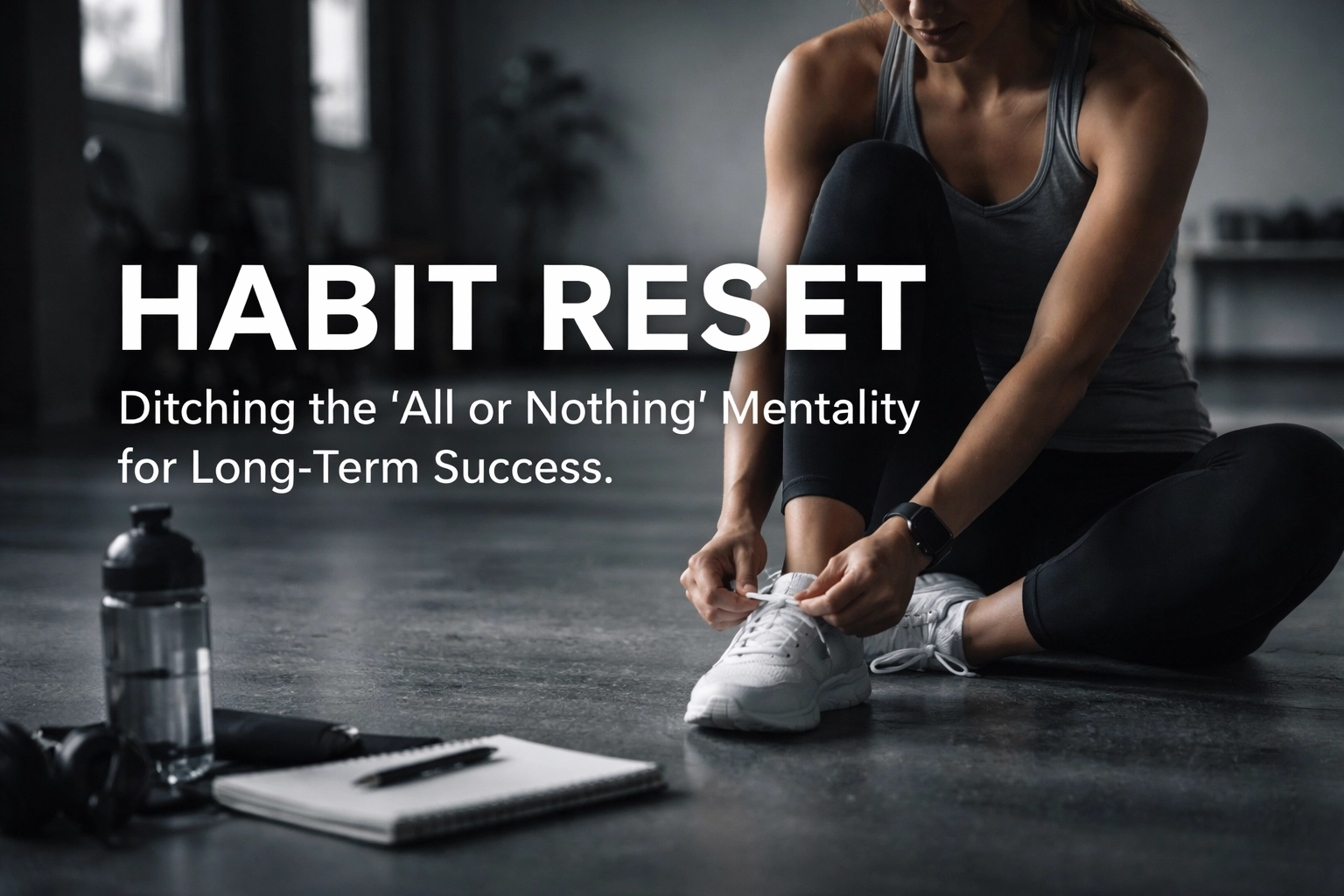
Research shows that all-or-nothing thinking reduces complicated issues into just two choices: and that binary approach is one of the biggest reasons people abandon their fitness goals within the first six weeks of the new year. If you’re a busy Austin professional who’s tired of the start-stop cycle, you’re not alone. Studies indicate that approximately 80% of New Year’s resolutions fail by mid-February, and rigid thinking patterns are a major culprit.
Here’s the truth: viewing any mistake or outcome short of perfection as complete failure creates an unsustainable cycle. It’s exhausting. And it’s keeping you stuck.
This post is the first in our New Year, Real Results series: designed specifically for high-performing Austinites who want sustainable fat loss and lasting health changes without the guilt spiral. Let’s break down how to ditch the extremes and build something that actually works.
Why the “All or Nothing” Approach Backfires
You know the drill. Monday rolls around, and you’re 100% committed. Meal prep is done, workouts are scheduled, and you’re ready to crush it. Then Wednesday hits: a last-minute client dinner, a kid’s school event, or just sheer exhaustion: and suddenly the “perfect” plan falls apart.
Instead of adjusting, you write off the whole week. “I’ll start fresh on Monday.”
Fact: This cognitive distortion causes people to view any slip as complete failure, which typically leads to inaction and maintains the status quo rather than creating lasting behavioral change.
The problem isn’t your willpower. It’s the framework. When success means 100% adherence and anything less equals failure, you’re setting yourself up for a cycle that looks like this:
- Overcommit → burnout → guilt → quit → repeat
Sound familiar? Let’s fix it.

5 Evidence-Based Strategies to Break the Cycle
1. Notice Your Binary Language
The first step is awareness. Start paying attention to the words you use: both out loud and in your head. Words like “always,” “never,” “should,” “perfect,” “good,” and “bad” are red flags.
Examples of all-or-nothing language:
- “I always fall off track.”
- “I should be able to handle this.”
- “That workout was a total waste: I couldn’t finish it.”
When you catch yourself using absolutes, pause. These are clues that you’ve slipped into rigid thinking. You can’t change a pattern you don’t recognize.
Action step: For the next 48 hours, write down every time you catch yourself using binary language around food, exercise, or productivity. No judgment: just data collection.
2. Challenge the Thought with Evidence
Once you’ve identified a rigid, negative thought, actively challenge it with a more balanced alternative. This isn’t about toxic positivity or pretending everything is fine. It’s about accuracy.
For example:
- Rigid thought: “I missed my morning workout, so today is ruined.”
- Realistic alternative: “Missing one workout doesn’t erase my progress. I can take a 20-minute walk at lunch or do a quick session tonight.”
Real-life examples matter here. Think back to times when things didn’t go perfectly but you still made progress. That’s evidence that the middle ground exists: and it works.

3. Find (and Embrace) the Middle Ground
There is no “perfect” approach to sustainable fat loss or habit building. Period.
Ask yourself: What would it look like to be gentler and more realistic with my expectations?
For busy Austin professionals juggling careers, families, and social obligations, the middle ground might look like:
- 3 workouts per week instead of 6
- 80% nutritious meals with room for flexibility
- A 15-minute movement session on chaotic days
- Hiring a personal trainer in Austin who understands your schedule constraints
The goal isn’t perfection: it’s consistency over time. Research consistently shows that moderate, sustainable approaches outperform extreme protocols for long-term results.
4. Start Smaller Than You Think You Should
Here’s where most people go wrong: they try to overhaul everything at once. New diet, new workout routine, new sleep schedule, new morning ritual: all starting January 1st.
That’s a recipe for decision fatigue and burnout.
A better approach: Pick one small thing and focus on doing that consistently: not perfectly, but “for the most part.” Once that habit feels automatic (usually 2-4 weeks), add another.
Examples of sustainable starting points:
- Drink one extra glass of water before your morning coffee
- Take a 10-minute walk after lunch three days per week
- Prep protein for the week every Sunday
Small wins compound. A 1% improvement daily leads to massive transformation over 12 months.
Fact: Focusing on the steps you can control: rather than fixating on perfect results: reduces anxiety and increases follow-through.

5. Create Default Plans to Reduce Decision Fatigue
All-or-nothing thinking thrives when you’re tired and overwhelmed. Every decision becomes a battle between “do it perfectly” or “don’t bother.”
The solution? Preset plans that remove the decision entirely.
Build defaults for common scenarios:
- Busy workday: “If I can’t make my full workout, I’ll do a 15-minute bodyweight circuit at home.”
- Client dinner: “I’ll choose protein and vegetables as my main course and enjoy one drink.”
- Travel week: “I’ll pack resistance bands and commit to 20 minutes of movement each morning.”
These aren’t compromises: they’re strategic adaptations. And they keep you in the game when life gets chaotic.
How This Connects to Sustainable Fat Loss
If your goal is fat loss that actually lasts, mindset is half the battle. The research is clear: extreme diets and punishing workout regimens may produce short-term results, but they rarely stick.
Sustainable fat loss happens when you:
- Create a moderate calorie deficit you can maintain for months (not days)
- Build muscle through consistent strength training (even 2-3 sessions per week works)
- Prioritize protein and whole foods without eliminating entire food groups
- Get adequate sleep and manage stress (cortisol directly impacts fat storage)
- Stay consistent over time: not perfect, consistent
The all-or-nothing mindset sabotages every single one of these pillars. It turns a minor slip into a week-long derailment. It makes rest days feel like failure. It convinces you that one “bad” meal ruins your progress.
It doesn’t. Progress isn’t linear, and your body doesn’t work in absolutes.
Celebrate the Small Wins (Seriously)
Many high achievers hyper-focus on the one thing that didn’t go as planned while ignoring dozens of successful choices. Sound like you?
Build a daily habit of acknowledging your wins:
- You chose the salad at lunch? Win.
- You got 7 hours of sleep? Win.
- You took the stairs? Win.
- You didn’t stress-eat during that brutal meeting? Big win.
These moments build momentum. They rewire your brain to look for evidence of progress instead of evidence of failure.

Treat Yourself Like You’d Treat a Client
If a colleague came to you frustrated about missing a deadline, would you tell them they’re a failure who should just give up? Of course not. You’d help them problem-solve and move forward.
Apply that same compassion to yourself. Self-criticism reinforces the all-or-nothing cycle. Kindness breaks it.
You’re building a lifestyle, not running a sprint. And lifestyle changes take time, patience, and a whole lot of grace.
Ready for Real Results This Year?
Breaking the all-or-nothing mindset is the foundation for everything else: better workouts, smarter nutrition, sustainable fat loss, and actual enjoyment of the process.
The difference between another failed diet attempt and lasting transformation lies in the approach. You need a system designed for your reality: demanding schedule, high stress, and ambitious goals.
Invictus Fitness’s in-home transformation program brings the concierge experience directly to you, eliminating commute times and scheduling conflicts while providing the personalized attention you need to succeed.
Stop trying to fit your life into someone else’s program. Let us create a fat loss strategy that fits your life instead.
Contact Invictus Fitness to begin your journey toward sustainable, convenient fitness that supports your success both in and out of the office.